
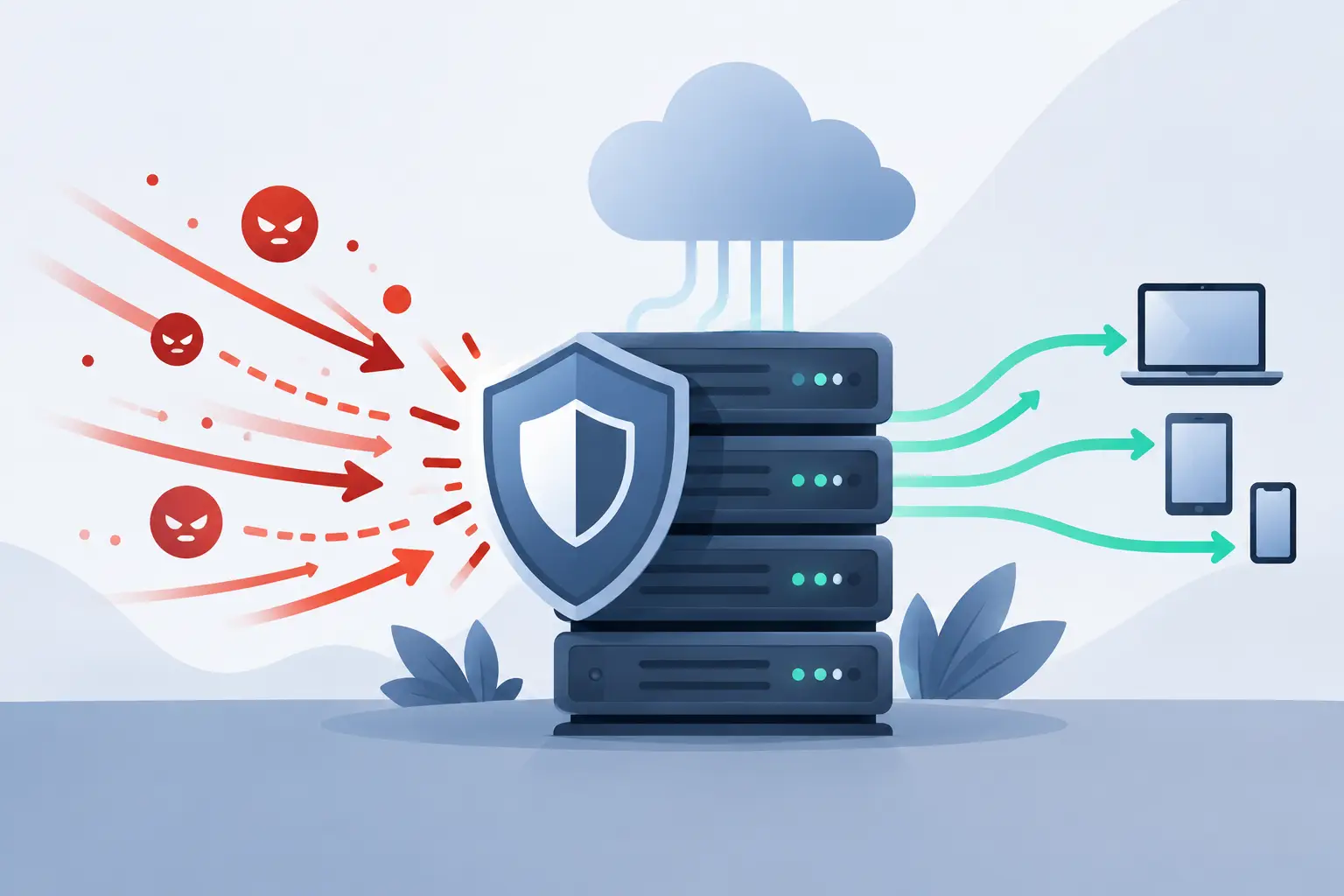
A VPS with Anti-DDoS protection is not a feature reserved for large companies. For anyone running an online store, API, game server, customer portal, trading operation or internal system, a few minutes offline can mean lost sales, urgent support tickets and frustrated users. Protection filters malicious traffic before it consumes your server's bandwidth and resources.
The main point is simple: more CPU, RAM and NVMe SSD will not solve an attack that saturates the network connection. If malicious traffic arrives without filtering, the server can become unreachable even with plenty of processing power. For this reason, Anti-DDoS protection should be part of your infrastructure choice, not treated as an optional extra.
What a DDoS attack does to your VPS
DDoS stands for distributed denial of service. Instead of coming from a single source, many machines or devices send simultaneous requests to the same target. The goal may be to exhaust bandwidth, open excessive connections, overload a specific service or simply take an IP address offline.
In practice, the symptoms appear quickly: a slow or unreachable website, failed RDP or SSH connections, players dropping from a game server, APIs that stop responding and trading platforms that become inaccessible at the wrong moment. For an agency or reseller, the impact can reach several clients hosted on the same infrastructure.
Not every traffic spike is an attack. A successful campaign, a live stream or a product launch can also increase usage. The difference lies in the traffic pattern. The role of the Anti-DDoS layer is to identify abnormal behavior and block or limit suspicious packets without stopping legitimate access.
How a VPS with Anti-DDoS protection works
In a suitable architecture, filtering happens on the provider's network, before the malicious volume reaches your VPS. This prevents your contracted connection from becoming congested and preserves the resources of the virtualized environment. The protection can analyze traffic volume, number of connections, protocols, ports and request patterns to apply mitigation rules.
Network-layer attacks, such as UDP, SYN or ICMP floods, usually require high-capacity filtering. Application-layer attacks, for example an excessive number of requests to a specific page or endpoint, may require additional adjustments on the server, the firewall, the web server or a reverse proxy. Therefore, Anti-DDoS does not eliminate the need for secure configuration.
This is where it is worth looking beyond the phrase "DDoS protected." Ask what mitigation capacity is advertised, whether the protection operates continuously, which protocols are covered and how support responds during an event. A protection of up to 120 Gbps, like the one offered on HostMF plans, suits projects that need to reduce exposure to volumetric attacks without moving to complex infrastructure.
When Anti-DDoS protection is really worth it
It makes sense whenever availability has financial, operational or reputational value. A simple corporate page may carry low risk, but it can still be targeted by unfair competition, vandalism or automated attacks. Applications with active users, paid services and remote access tend to feel the impact immediately.
For e-commerce and customer service systems, an outage during business hours means lost opportunities and a poor experience for customers. For APIs, n8n automations, integrations and applications, downtime can interrupt workflows that depend on constant communication. Developers hosting staging or production environments also avoid having an external attack halt their team's deliveries.
Game servers are frequent targets because an interruption affects an entire community within seconds. Projects running Minecraft, bots, voice servers and other multiplayer services need to consider not only performance but also the ability to stay accessible under abnormal traffic.
Traders using MetaTrader, Profit Pro and Forex platforms face a different scenario. An attack does not necessarily interfere with execution by the broker, but it can take offline the remote desktop, the trading robot or access to the terminal installed on the VPS. Anyone who depends on continuous operation should combine Anti-DDoS protection, appropriate location, monitoring and resources compatible with the platform in use.
Anti-DDoS does not replace good server practices
Hiring a protected VPS reduces an important class of risk, but it does not fix application flaws or exposed credentials. An outdated WordPress installation, an administrative port left open without restrictions, weak passwords or a poorly configured panel remain entry points for incidents.
The security baseline should include regular updates to the operating system and applications, unique and strong passwords, SSH keys where applicable, a firewall allowing only the necessary ports and tested backups. On Windows VPS, it is worth restricting RDP access by IP whenever possible and keeping well-defined authentication policies. On Linux, firewall tools and blocking of repeated login attempts help reduce the attack surface.
There is also a balance to consider. Overly strict filtering rules can block legitimate access, especially in applications that use many UDP packets, simultaneous connections or external integrations. For this reason, effective protection should allow analysis and adjustment according to the profile of the service, rather than applying a generic rule to every case.
How to choose the right plan for your project
The first criterion is understanding what will be hosted on the VPS. A website with moderate traffic needs a different configuration than a game server, an operation with dozens of trading accounts or a stack with databases, containers and deployment panels. CPU, RAM and NVMe SSD should match real usage, because network protection does not compensate for insufficient internal resources.
Location also matters. For Brazilian audiences and remote access from Brazil, a VPS in Brazil can reduce perceived latency. For applications aimed at international users or services that depend on a specific region, Canada and Europe may be more suitable options. The best choice depends on where your users, integrated systems and operations team are located.
Before signing up, evaluate these points:
- stated mitigation capacity and whether the protection operates continuously;
- available bandwidth and network usage policy;
- root or administrator access for customizing the environment;
- operating system and panels compatible with your project;
- activation time, support channels and the ability to scale resources.
For those who want autonomy, a Linux or Windows VPS with administrative access lets you install tools, configure rules and define your own stack. For those who prioritize speed, panels such as cPanel, aaPanel, EasyPanel, CyberPanel and Coolify reduce the time needed for publishing and management. The best setup is not the most complex one; it is the one that gives you enough control without creating unnecessary operational work.
What to do when an attack happens
If the service suddenly slows down or becomes unavailable, start by checking network, CPU, memory and process metrics. A rise in incoming traffic unrelated to normal usage is a relevant sign, but not the only one. Logs from the firewall, the web server and the applications help distinguish a volumetric attack from an internal failure or a legitimate traffic peak.
Avoid impulsive decisions, such as repeatedly restarting the VPS or opening additional ports without need. If protection is already active on the infrastructure, the right path is to record the time of the problem, the affected IP or domain and the services involved, then contact technical support. This information speeds up analysis and helps adjust rules when necessary.
External monitoring also makes a difference. It shows whether the failure is noticed by users outside your network and creates a useful history for identifying recurring issues. For critical projects, it is worth keeping recent backups and documenting a response procedure, even if it is simple.
Anti-DDoS protection is most valuable when it is chosen before the first incident. If your project depends on availability, treat the infrastructure as part of the product you deliver: with adequate resources, monitoring and a defense layer ready to keep the service accessible when the pressure increases.